Archive for the ‘Uncategorized’ Category

what a day

Tuesday, January 15th, 2008

Robot Laurel called my bluff on this one and we drove early this morning to Snoqualmie pass and went on a nice climb up the mountain on skis. Eventually we had to come down which was interesting on rental skis. My legs are tingly and devastated from all the snowplowing down.

A beautiful winter day.

Bald Women Do Lunch

Friday, July 6th, 2007

Thought I’d pass along a link to Bald Girls Do Lunch, a non-profit for women with alopecia based in the NY area.

Bald Girls Do Lunch provides new and valuable opportunities for women with alopecia areata – an auto-immune skin condition which causes the partial or total loss of hair on the scalp, brows, lashes and body. We are a not-for-profit organization dedicated to improving the self-confidence of women who share the challenges of this condition.

Go BGDL!

it ate my gums

Wednesday, May 30th, 2007

Like most folks I started using a Sonicare toothbrush at the behest of my dentist. Actually, three seperate dentists over the years asked me to use it. And sure enough, less plaque on my teeth come cleaning time. However, over time my dentist began telling me that my gums were receding faster than made sense. I have clean teeth and floss twice daily. So, I was told to focus brushing the gums to stimulate the tissue. Long story short, I underwent a tissue transplant to replace my gums below my lower front teeth. Not a trivial thing.

The oral surgeon who performed the procedure said that 80% of his clients have receded gums from Sonicare. The other 20% is split between older patients and those that have chewed tobacco. The moral of this story: Beware The Sonicare!

my 8th loaf

Wednesday, January 10th, 2007

Today I baked a round loaf of rustic breadh. I feel like I’ve finally worked out a few of the kinks with Jim Lahey’s Sullivan Street Bakery no-knead recipe. Hopefully it tastes as good as it looks. I gave it to Josh for his family dinner tonight. My 7th loaf was delicious so I’m predicting good times for the Petersens tonight.

I plan to bake a couple more loafs tonight to give to people.

I give it 60/40 odds working out

Tuesday, December 12th, 2006

That’s a 60% chance that we can revive this vending machine found abandoned in a parking lot down the street. Eric is going to help out. Our goal is to get it cleaned up and working so we can donate it to McLeod for the member’s room.

Buster is giving us until New Years Eve to get it going. If anyone else is interested in helping and knows something about refrigeration or old vending machines jump on in. It’s currently in my garage.

Fender Rhodes tour rig

Friday, October 20th, 2006
/

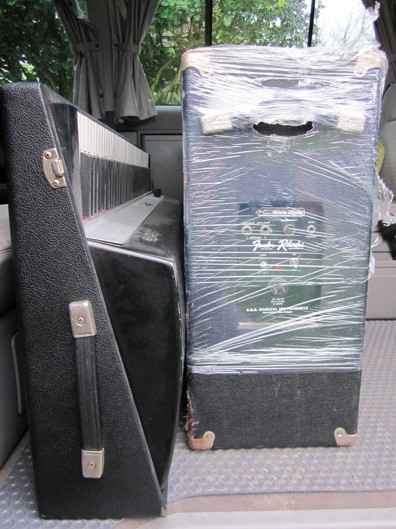
I put 9 pictures on Flickr as it’s best described in pictures. The greatest part about this Rhodes is it’s been overhauled by David Ell one of the prominent Rhodes technicians living today.

In addition, I’d love to sell off the entire tour rig that supports this rhodes. Namely …

  1. road case for Rhodes
  2. effects pedals (delay, tremolo, phaser)
  3. Quiklok stand
  4. rhodes sustain pedal and rod
  5. road case for holding effects, stand, sustain pedal and cords

goodbye pigeons

Friday, October 20th, 2006
/

It’s been one week and the pigeons have not returned. The hole they were accessing has been closed up with chicken wire. The attic is still full of pigeon shit and feathers, but at least they’re gone. It was driving me completely nuts.

A big clean-up job awaits.

I’m torn

Saturday, September 23rd, 2006
/

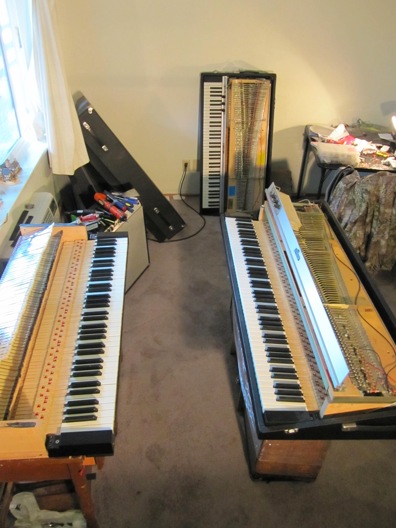
I’ve had my 88 key Rhodes suitcase model (bottom pic) for many years. I don’t even know where I originally purchased it. Maybe the Trading Musician? But I didn’t pay much. However, over the years I’ve had a lot of restorative work done on it. And the restoration and tuning holds a lot of meaning for me.

Let me back up. A while back I went on a major purge of gear. I kept everything that I thought was essential or at least highly enjoyable and pleasing. I have a thing for fixing up old instruments—in the past I’ve owned as many as 5 Fender Rhodes at one time, not to mention 2 Hammond B3s, 3 Leslie speakers, lots of synths, guitars, etc. I’m done with that game, but I do like having a few nice instruments that I use.

That’s kind of where this Rhodes teeters: between something I use less and less but enjoy as a physical object—and something that I think might just be taking up space in my house.

The first major overhaul on this Rhodes was performed by a locally-famous piano tuner named Bill Nye (not to be confused with Bill Nye the Science Guy). He was meticulous beyond measure and went to the trouble of counterbalancing every one of the 88 keys with keyleads so they were properly balanced and weighted. Nobody ever does this to a Rhodes. This impressive feat was performed out of love—because Bill hated the Rhodes as a “crude” instrument but loved me and my brother. So, we struck a deal and traded him 1,100 bottles of Diet Peach Snapple to counterbalance, regulate and generally overhaul the guts of this Rhodes. Why? Because that summer Bill drank 2 or 3 Diet Peach Snapples a day—OCD. We didn’t have much money, but Greg (my bro) was working on a Snapple campaign handing out free samples of Snapple around Seattle. Which means that “free” Snapple samples paid for a big part of my Rhodes overhaul.

A few years later I met who I consider to be one of the premier Rhodes technicians in the world today, David Ell. David was kind enough to refinish the tolex and regulate my 88-key Rhodes in Kennewick, WA. He gave me a hell of a deal as we were both kind of kick-starting each other’s music careers. He was helping repair and enhance all my Fender Rhodes for tour and studio use while I spread the word about Dave’s incredible Rhodes technician prowess. Honestly, this guy is a bit of a genius as it relates to understanding the physics and repair of the Rhodes mechanism.

And here I am today seriously considering selling off this Rhodes with all my memories attached. From Snapple to Kennewick and back—rooming with my brother in Wallingford and dragging my crazy gear around to find crazy people to work on it for next to nothing. But loving all the bartering and comraderie involved.

I think it’s time to let go of the Rhodes, but I had to type through it.

P.S. RIP Bill Nye (death by spider bite of all things). I truly hope you enjoyed the Diet Peach Snapple. Your workmanship lives on in this Rhodes.

One thing you probably didn’t know about Marge

Wednesday, June 7th, 2006

My mother was the first Jesuit Volunteer …

Modest beginning in the Last Frontier: Five women came to Alaska in 1956 as volunteer teachers. Fifty years later, their work here is seen as the beginning of an international Catholic service organization.

By Effie Caldarola
Anchor Writer

Marge Spils didn’t know she was making history when she headed north in 1956 to teach as a volunteer at Copper Valley School near Glennallen. The young Massachusetts college graduate — then Marge Mannix — just believed that it was another adventure, and for a good cause. She was joined by four other young women from Catholic colleges in Massachusetts, all of them persuaded by a warm-hearted Sister of St. Ann to come north to the missions. For the first couple of months, the women had to cross a stream to use an outhouse, and they learned how to plaster walls and glaze windows before the classrooms were ready for them to start their work of teaching. A friendly lodge owner let them take a weekly shower.
Fifty years later, that small group of women is heralded as the beginning of what was to become the Jesuit Volunteer Corps, now a national and international organization celebrating its 50th year.

The funny thing, Jesuit Father Tom Gallagher told the Anchor last week, is that even though the corps bears the name “Jesuit” now, a St. Ann Sister really came up with the whole idea. Sister George Edmond traveled to the East Coast to Catholic women’s schools who had lay apostolate programs, Father Gallagher explained. With slide shows and lectures, she recruited young women for Copper Valley, a boarding school serving mostly Native students that was operated jointly by the Jesuits and St. Ann Sisters. The Jesuits, who brought young men from Jesuit universities to help out during the summers at the school, knew a good thing when they saw it, and by the 1960s, they too were inviting young college graduates to join the newly named “Jesuit Volunteer Corps.”

The JFK connection
Anniversaries are a good time to ask some questions. Was the Jesuit Volunteer Corps really the model for President John F. Kennedy’s Peace Corps, as rumor has it? And what exactly does it mean to be, as the corps’ informal motto promises, “ruined for life?”. Spils, now a member of Holy Family Cathedral in Anchorage, said President Kennedy definitely paid a visit to her alma mater, Regis College, and asked the sister who directed the lay apostolate program, ” ‘If people will do this for the church, do you think they’d do it for the country?’”. As for being “ruined for life,” ask a former volunteer about it and they’ll probably smile and proceed to tell you how the corps changed everything. Marti Pausback was part of Anchorage’s first Jesuit Volunteer Corps community in 1985. A Colorado State University graduate, Pausback grew up in Aspen — a place she describes, along with her parish, as “rich, happy and white.” The Jesuit Volunteer Corps showed her “things I wouldn’t have seen”. “It shaped how I feel about the church,” Pausback said, giving her a “new image of the church which included social justice” as well as inclusiveness — “a join-us-at-the-table kind of thing”. Cathy Miller of Anchorage, a teacher, St. Elizabeth Ann Seton parishioner and mother of five grown children, was a Jesuit Volunteer in St. Marys, Alaska, from 1971 to ’73. “It set my life going in a new direction,” said Miller, a native of San Francisco. “I thought it would be a good adventure, but I never thought I’d be so influenced to live a life of service”. Like many Jesuit volunteers, Miller found her life partner, Tom, in the corps.

The Millers emphasized social justice in their family, Cathy said; their daughter Colleen, 24, became a second-generation Jesuit Volunteer in Birmingham, Ala., last year. Another daughter served in the Peace Corps. Jesuit Volunteers continue to serve in Alaska.
Heather Coulehan spent 1992-93 as a Jesuit Volunteer in Anchorage at Abused Women’s Aid in Crisis (AWAIC) and later spent two years, 2002 and 2003, teaching with Jesuit Volunteer International in South Africa. She remembers longingly the liturgies in South Africa: Masses full of rhythm and movement. Even the gifts were “danced” to the altar, she said. Retreats were also an important part of her corps life, she said. Volunteers are provided with three or four spiritual retreats during their volunteer year.

Ruined
So what is this “ruined for life” business? It’s a value thing, Cathy Miller said. Most former volunteers she knows are not wealthy — they don’t value “success” in the classic American way.
Coulehan agrees that the corps produces a counter-cultural effect in people, a way of looking at materialism, spirituality and the vulnerable that’s different from the norm. “I think it’s all about connections,” she said. “Connecting with people and your community on a different level. You see connections on a spiritual basis.”

According to a recent survey conducted by Fairfield University, the corps is acknowledged by most volunteers to be a touchstone experience of their lives. The survey of 5,000 former volunteers found that 98 percent feel that volunteer activity is important to citizenship, versus 74 percent of other Americans. It also found that 96 percent to 98 percent of former Jesuit volunteers donate to charity, regardless of income, and donate 25 percent more money than the average American household. The survey also found that of the four core values of the corps — spirituality, community, simple living and social justice — all remained important to the majority of respondents, with 86 percent saying social justice was important or very important in their current lives.

James Noonan, 24, is a Jesuit Volunteer this year at Covenant House in Anchorage. He graduated from a Jesuit school, Boston College, where he said he learned about “putting social justice talk into action” through a program called “Four Boston” — four hours of community service a week plus one hour of group reflection.

He joined the Jesuit Volunteer Corps hoping “to root myself” in the Ignatian concept of “contemplation in action,” and he hopes to carry that value on to a career in medicine (St. Ignatius of Loyola was the founder of the Jesuits). Pausback, who spent two years at McAuley Manor, a home for girls operated by Catholic Social Services, was a biology major in college. But she’s continued in the social service field — not unusual, according to the Fairfield University survey, which found 18 percent of former Jesuit volunteers work in the nonprofit sector, versus 7.4 percent of the general population. According to Jeanne Haster, executive director of Jesuit Volunteer Corps: Northwest, about 350 Jesuit Volunteers serve nationally each year, with about 40 international placements.

More than 85 volunteers will serve in the Northwest region next year, a larger number than the previous year but considerably lower than earlier years. The growing debt burden on college graduates is a factor, said Haster. Also, she said, in a sense the corps has been a victim of its own success. Volunteer organizations, both secular and religious, have mushroomed in the 50 years since five women made history at an isolated boarding school in Alaska.

I’ve been enjoying cash money lately

Wednesday, May 24th, 2006

If someone came along and invented cash money today (with credit and debit cards being in such wide use) it would probably seem like a crazy thing. How to instill a sense of value in hand-exchanged notes and coins? But I’ve really been enjoying cash more than ever recently. A lot of it has to do with being able to better track my spending emotionally — parting with paper money still means something to me. And I’ve been talking with Ivan, Josh and others about the problem with Wal-Mart and the benefits of local economy and local joints. Nothing too new here, but I do notice that a few of my favorite local joints prefer cash as they don’t get hit with credit/debit card processing fees. It does a small part in evening the playing field between the big and small players. Staying more local-focused in my activities feels right when I walk to a place, spend cash and feel good about immediately supporting my local hangouts without burdening them with processing fees. Example: some coffee stands near my house either don’t take credit cards or add on an additional fee for charges under, say, $5. It’s expensive to process those cards when people are buying a $2 drink from you! Also, the other night at Town Hall I handed over a $5 bill and the line moved right along — no credit cards makes for an efficient line. One fella was insulted that they don’t take credit cards. I say keep it that way! It’s easier for Town Hall to count the money at the end of the night, the line moves fast and the price point can remain at a comfortable $5.

I don’t know if tracking all my small, local purchases online is really that helpful to me as much as seeing the money in my pocket and feeling the value as I hand it over. Long live green.